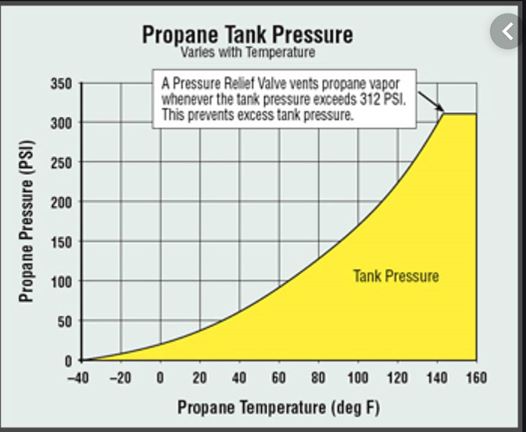
Propane Gas Vaporization Chart
This table shows the amount of BTU's available at the % full level at different temperatures.
| 20 LB. Bottle | |||||
| % FULL | +20F | 0F | -5F | -10F | -15F |
| 60% | 36,000 | 18,000 | 13,500 | 9,000 | 4,500 |
| 50% | 32,400 | 16,200 | 12,150 | 8,100 | 4,050 |
| 40% | 28,800 | 14,400 | 10,800 | 7,200 | 3,600 |
| 30% | 25,200 | 12,600 | 9,450 | 6,300 | 3,150 |
| 20% | 21,600 | 10,800 | 8,100 | 5,400 | 2,700 |
| 10% | 16,200 | 8,100 | 6,075 | 4,050 | 2,025 |
| 30 LB Bottle multiply X 1.40 | |||||
Why Does Cold Weather Reduce Propane Flow?
It all comes down to how propane behaves inside the cylinder. Propane is stored as a compressed liquid, but your RV appliances (like the furnace, water heater, and stove) only burn propane vapor. In order to create that vapor, the liquid propane must boil.
Propane has a boiling point of -44°F (-42°C). When the outside air is warm, heat transfers easily through the steel walls of the cylinder, causing the liquid to boil rapidly and produce plenty of vapor pressure. However, as the outside temperature drops closer to that -44°F mark, the boiling process slows down dramatically. Less boiling means less vapor pushing through your regulator to feed your appliances.
The "Wetted Surface" Factor
Temperature is only half the equation. The propane liquid absorbs heat from the outside air only where the liquid actually touches the inside walls of the tank—this is called the wetted surface area. As your tank empties, there is less liquid touching the walls, meaning less heat transfer. A nearly empty tank in freezing weather simply cannot boil fast enough to keep up with the high BTU demand of a standard RV furnace.