
RV Refrigerator Repair - Problem Solving
No Cooling on any fuel source
This situation indicates a problem with the cooling unit, itself. Follow the steps below to determine the
cause.
For an explanation of how the cooling unit operates see how it works.
Testing the Cooling Unit
Testing by " Feel "
For this method of testing the only tools required are your hands! CAUTION: some of the components may be HOT! Be careful!
If a cooling unit is operating properly, there should be approximately the same amount of heat in the middle sections of the boiler and absorber.
Cooling unit blockages
When a cooling unit malfunctions due to a blockage, the boiler section may be too hot to touch and the absorber will be relatively cool. Any blockage reduces the free flow of the solutions and will inhibit or completely prevent proper operation.
A blockage is caused when the fridge is operated in an off level condition. The heat that is generated by the propane flame or the electric heating element is the force that initiates the cycling of the solutions inside the cooling unit. This action is similar to the familiar coffee percolator where the water is lifted by the heat and flows by gravity down over the coffee grounds.
The refrigerator depends on gravity to move the solutions through the system once the heat source has lifted the solutions to the top of the cooling unit. The passages that the solution must travel through have only a slight slope to them and any off-level condition will hinder this gravity flow. Parking on a hill, with your refer running while you go off to lunch, starts the degradation of the system and every time you do this, it adds up. There is no way to reverse this problem.
What happens in this situation, is that the solution in the cooling unit gets overheated, and a component of this solution crystallizes and becomes solid particles that float around and lodge where they're not supposed to.
Tipping the refer upside down, may or may not, dislodge the particles, but they are still in there and will (sooner or later) plug things up again.
You have two choices ... replace the cooling unit (new or recharged) or replace the entire refrigerator.
A new refer or a new cooling unit, comes with a one year warranty. In my area, a rebuilt cooling unit comes with a five year warranty - figure that one out!
Leaking Cooling Unit
If the boiler is warm and the absorber is hot this indicates that a leak has developed and the hydrogen gas has escaped. The liquid ammonia does not change to a vapor without the hydrogen gas atmosphere and circulates as a liquid. A strong ammonia smell is a definate sign of a leak. The cooling unit must be replaced or re-built.
There is a chemical called sodium chromate in the solution that circulates inside the cooling unit. It is there to prevent the ammonia/hydrogen/water solution from corroding the steel tubing. If a leak developes, this chemical changes from a liquid state to a powder in the presence of air. A yellow residue on the outside of the cooling unit indicates a leak.
Advanced testing methods
Dometic recommends the following method for testing the cooling unit:
1. Make sure the unit is level.
2. Hook up the 110 VAC element directly to a 110 volt source, in effect bypassing the thermostat and control systems. To do this, locate the two white wires coming from the 110 volt heating element. The heating element is located in the cylindrical tin casing surrounding the burner flu, and is accessible through the removable panel on the side of the casing. If you have a three way refer there should be two elements side by side. The 12 volt element can be identified by noting the way the wires are connected. The 12 volt element has one wire connected directly to the element and the other wire connects with a spade type of terminal. The 110 volt element has both wires connected directly to the element. Also, if you fully remove the elements, the voltage will be stamped on the casing.
Disconnect the two wires at the terminal block and connect these wires directly to a 110 volt source. If you are not comfortable or sure about what you are doing, then this test is best left to your RV Technician.
3. Place a thermometer in a glass of water and place in the food compartment. It is important to use the glass of water for this test as it equalizes the temperature reading.
4. After 12 hours the temperature should be 43 deg. F or less.
5. After 24 hours the temperature should be between the low 20's to high 30's maximum. If these temperatures are not reached and maintained, then the the cooling unit is faulty and should be replaced or rebuilt.
LPG Flame Outage Problem
The first steps to undertake are to clean the flue, the burner tube and the orifice. Remove the rear access
cover on the outside of the coach. On the right lower side of the refrigerator, there is a tin cover which you
remove to access the burner. The flue, or chimney, is located right above the burner flame. Often, a flakey rust
colored residue falls from the flue and clogs up the burner ( this is a result of combustion and is a normal
occurrence). This residue will also interfere with the sensor probe and flame outage will result.
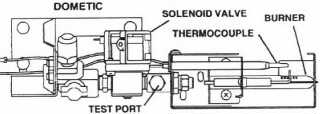
Use compressed air to blow out the flue and the surrounding area. Remove the screw holding the small tab that holds the thermocouple in place. The thermocouple is a narrow rod with the end that sticks into the burner flame. Pull out the thermocouple to access the two screws that hold the burner assembly in place.
Remove the burner tube and soak it in alcohol for 15 minutes, then let it air dry.
The orifice is located just to the left of the burner tube and is a brass colored nut with a very tiny hole in it.
Remove this a let it soak in alcohol also. Do not probe or poke anything into the orifice to clean it - this will
drastically affect the flame characteristics and will render the orifice useless. Once soaked and dried, you should
be able to hold it up to a light source and see the light shining through the orifice opening.
Re assemble every thing and light the burner flame. A normal flame will be a "hard blue" color with no yellow tip, and will emit a slight roaring sound. If you still have a flame outage problem then the electrical circuitry is most likely the cause.
The Electric Heating Element
The electric heating element supplies the neccessary heat for refer operation on shore power. It is located at the rear of the refer as shown here (under the cover marked #6).
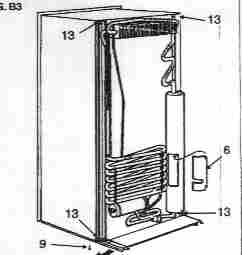
The element can be checked with an ohm-meter. Be sure to disconnect the 110 volt power cord and the 12 volt supply before working on the unit. On three way refrigerators there will be two heating elements - on a two way model, there will be only one. Note: some older models had a combination 110 volt and 12 volt element in one casing.
Locate and disconnect the wires leading to the element. With the multi-meter set on ohms reading, check the resistance of the element.
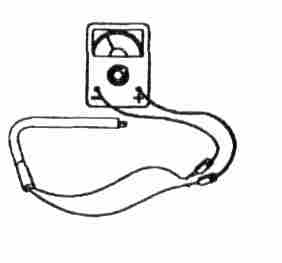
A zero reading indicates an internal short inside the element - an infinite reading shows an open circuit - in either case, replace the element. The correct reading varies from model to model.
Extreme cold weather caution!
The solution in the cooling unit contains water, ammonia and hydrogen. Normally this solution will not freeze. However, under extreme conditions (-30C or -20F degrees or so), there is a possibility that the cooling unit will freeze. This creates a blockage and when the heat source is called for by the thermostat, an overheat condition will be caused.
This overheat will damage the boiler and ruin the cooling unit.
If you must run the refrigerator is this situation, you can put a small heater or 60 watt light bulb in the outside fridge compartment to keep the unit from freezing. If possible, turn off the refrigerator until temps moderate.
I found this article from the rv_answer_guy ...)
Start quote --- Of Special Note: Your RVs Refrigerator is very vulnerable in cold weather. Your RVs refrigerator has chemicals in the cooling unit that will gel up like diesel fuel if the outside temperature gets down too far. This will stop your refer from working properly. There needs to be a certain amount of heat in the vented compartment behind the refer for it to operate as it should. For that reason, it is important to park your RV so the back of the refrigerator gets as much southern exposure as possible. While this will not guarantee that your refer will continue to work, this will help.
If that is impossible to do or if it is extremely cold, you can open the access door on the outside of your RV and add a bat of UNFACED FIBERGLASS INSULATION to cover the vent holes in the lower compartment access, thereby slowing down the circulation of air through the compartment and keeping some of the heat in. A single bat of unfolded and unfaced R11 should be good enough.You are not trying to completely block off the vent... you Just want to slow down the movement of air through the compartment on the backside of your refer.
NOTE: Use only UNFACED fiberglass insulation as it is not adversely affected by heat sources or open flame. AS a suggested rule, place the bat in the compartment when the outside temperature gets down to and stays below 15 degrees... just remember to pull the bat out the next spring or the refrigerator will run too hot and will stop working as well. NEVER cover or block the upper vent.
In conjunction with the UNFACED fiberglass bat, I've seen the use of a small shielded 60 watt bulb in the bottom of the compartment to help further provide heat to the cooling unit in cold weather as well. Just insure if you use the bulb, place it in a drop light socket with shield and place it away from wires or anything else it may come in contact with.
THE MAJOR REFRIGERATOR MANUFACTURERS FROWN ON THIS PRACTICE SO, IF YOUR REFRIGERATOR IS STILL UNDER WARRANTY, YOU MAY WANT TO FIND AN ALTERNATIVE MEANS TO KEEP YOUR FOOD COOL. The major manufacturers provide for no preventive maintenance in this area. It was explained to me that an RV refrigerator goes in an RV... Following that thought, an RV is what it is... a RECREATIONAL VEHICLE, and the use of their product was not intended for extreme cold weather operation.
Thus so, the procedure for a frozen cooling unit is to remove it from the RV and let it thaw in a heated garage or room for at least 72 hours or more and then retest it for operation before re-installing it. Why wait for it to freeze in the first place? Preventive maintenance is the key.
As a note, I've also seen owners fill the outside of the refer access panel with the grey or white split styrofoam pipe wrap. They just cut them to length and fill the three vents, so commonly seen on Dometic and Norcold access panels. These syrofoam tubes fit snug and, because they are on ther outside of the access panel, they make more room for a drop light and are seen easily so, come spring... you will remember to remove them.
So ,how do you know when your refrigerator is froze up? It is a pretty good indication that the chemicals have gelled up is when:
The outside temperature has been below 15 Degrees F or less for several days
The refrigerator has stopped cooling on the inside
Touching the Chimney (Commonly a silver vertical tube on the right side of the back of the fridge behind the access panel) is warm while at the same time, the absorber vessel ( a big grey or black horizontal canister sitting the middle of all of the tubes in the back of the fridge, also behind the access panel) is cold.
To prevent damage to the cooling unit, immediately TURN OFF YOUR REFRIGERATOR AND CALL A SERVICE TECHNICIAN.
NOTE: AFTER your refrigerator is froze up, the ONLY thing an RV Technician can do is remove the unit and place it in a warm place for 48 to 72 hours to let it thaw out. He must also test it for proper operation before re-installing it in your RV. -- End Quote